
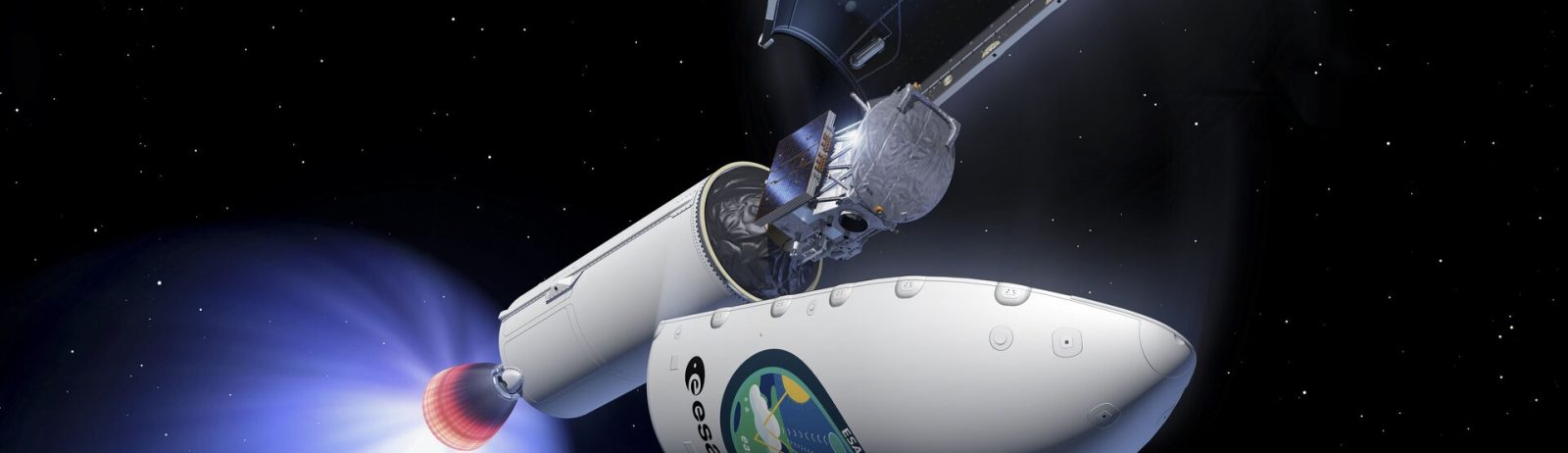
Launch of EarthCare satellite
EarthCARE, the most complex of all of ESA’s Earth Explorer missions, will quantify and reduce the uncertainty about the role that clouds and aerosols play in heating and cooling Earth’s atmosphere – contributing to our better understanding of climate change.
Understanding and monitoring Earth’s radiation balance is crucial for addressing climate-related issues and is something that can only be done from space.
Developed as a cooperation between ESA and the Japan Aerospace Exploration Agency (JAXA), EarthCARE will examine the role that clouds and aerosols play in reflecting solar radiation back into space and also in trapping infrared radiation emitted from Earth’s surface.
EarthCARE will, for the first time, measure vertical profiles of cloud particles and aerosols, and their fall speed – providing new insights into interactions between clouds, aerosols and precipitation. It will also register the distribution of water droplets and ice crystals and how they are transported in clouds.
This essential data will improve the accuracy of both cloud development models and their behaviour, composition and interaction with aerosols, as well as improve future climate models and support numerical weather prediction.
As part of the MAESTRO (Mesoscale organization of tropical convection) campaign, AERIS will be retrieving data from EarthCare for the purposes of the measurement campaign. If you need EarthCare data for your atmospheric science project, please fill in the AERIS call for projects form!
To follow the launch online on 28/05 from 23.30 PM:


