The international WHIRLS campaign: understanding the role of fine-scale ocean structures in climate and ecosystems

From 20 June to 29 July 2026, the international oceanographic campaign WHIRLS (The impacts of ocean fine-scale whirls on climate and ecosystems) is taking place off the coast of South Africa, in the Agulhas Current system. This multidisciplinary expedition aims to gain a better understanding of the role of fine-scale ocean structures in the exchange of heat, carbon and nutrients between the ocean and the atmosphere, as well as their influence on the dynamics of marine ecosystems.
WHIRLS is the flagship campaign of the ERC Synergy WHIRLS project, funded by the European Research Council (ERC). It brings together research teams from GEOMAR (Germany), ENS–PSL (France), the University of Gothenburg (Sweden) and the University of Cape Town (South Africa). In France, the project is supported by the IR* French Oceanographic Fleet, the CNRS-INSU, the CNES and the Data Terra research infrastructure, through the ODATIS (ocean), AERIS (atmosphere) and PNDB (biodiversity) clusters.
An exceptional natural laboratory
The Aiguilles Stream system is one of the most powerful and complex western boundary currents in the world’s oceans. It plays a major role in the exchange between the Indian and Atlantic Oceans, contributes to global ocean circulation and influences the climate at both regional and global scales.
Within this system, small-scale oceanic structures develop — eddies, fronts and filaments — ranging in size from a few kilometres to several tens of kilometres. Although small and short-lived, these structures control a significant proportion of the vertical exchange of heat, carbon and nutrients, promote carbon sequestration and shape marine ecosystems. However, their small size and rapid evolution make them particularly difficult to observe.
An integrated monitoring strategy
The WHIRLS campaign is implementing an unprecedented observation strategy, combining in situ observations with satellite measurements of high spatial and temporal resolution. The physical, chemical, biological and biogeochemical properties of the ocean are being measured simultaneously in order to characterise the interactions between the ocean, the atmosphere and marine ecosystems.
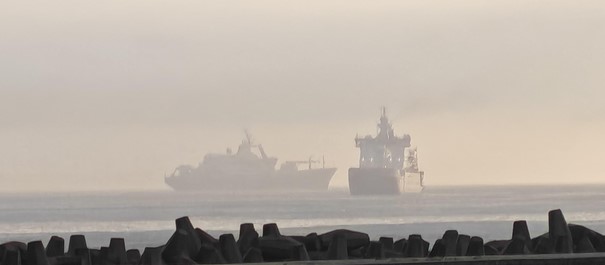
The deployment comprises two research vessels — the Marion Dufresne (French Oceanographic Fleet) and the SA Agulhas II (South Africa) — as well as an MVP300 (Moving Vessel Profiler) towed profiler, nearly 200 surface drifters, underwater gliders, biogeochemical profiling floats and marine drones. This combination of observations makes it possible to document ocean processes with unprecedented resolution.
Crucial support from the SWOT satellite
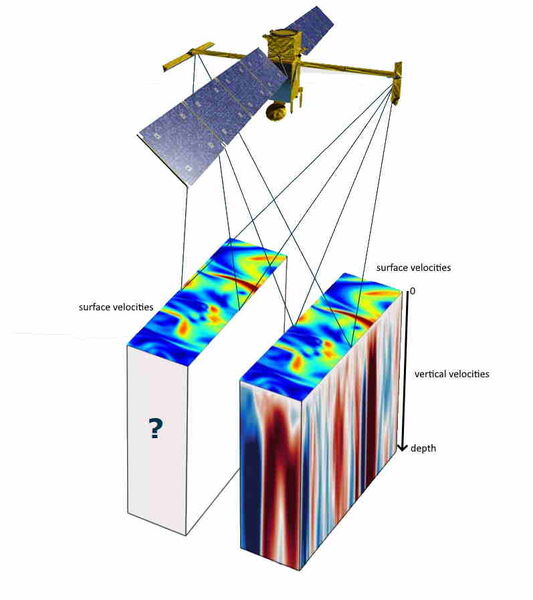
The campaign is closely coordinated with observations from the SWOT satellite, developed jointly by CNES and NASA. Thanks to its wide-swath interferometric altimeter, KaRIn, SWOT observes variations in the ocean surface at a resolution five to ten times higher than that of conventional altimetry missions.
The measurements acquired during the campaign will be used to validate satellite observations and to assess SWOT’s ability to capture the dynamics of fine-scale structures. In particular, they will help to improve estimates of vertical velocities in the ocean, a key parameter for quantifying the exchange of heat, carbon, nutrients and other tracers between the surface and deeper layers.
Better understanding of ocean–atmosphere exchanges
Heat, carbon and material exchanges between the ocean and the atmosphere play a crucial role in regulating the climate. A significant proportion of these transfers is driven by vertical movements associated with small-scale structures, whose characteristic dimensions range from one to ten kilometres.
These vertical velocities remain very difficult to measure directly at sea. By combining in situ observations, satellite measurements and numerical modelling, the WHIRLS campaign will enable these processes to be better characterised and their representation in ocean and climate models to be improved. The expected results will contribute to a better understanding of the ocean’s role in the climate system and its influence on marine ecosystems.
AERIS campaign support
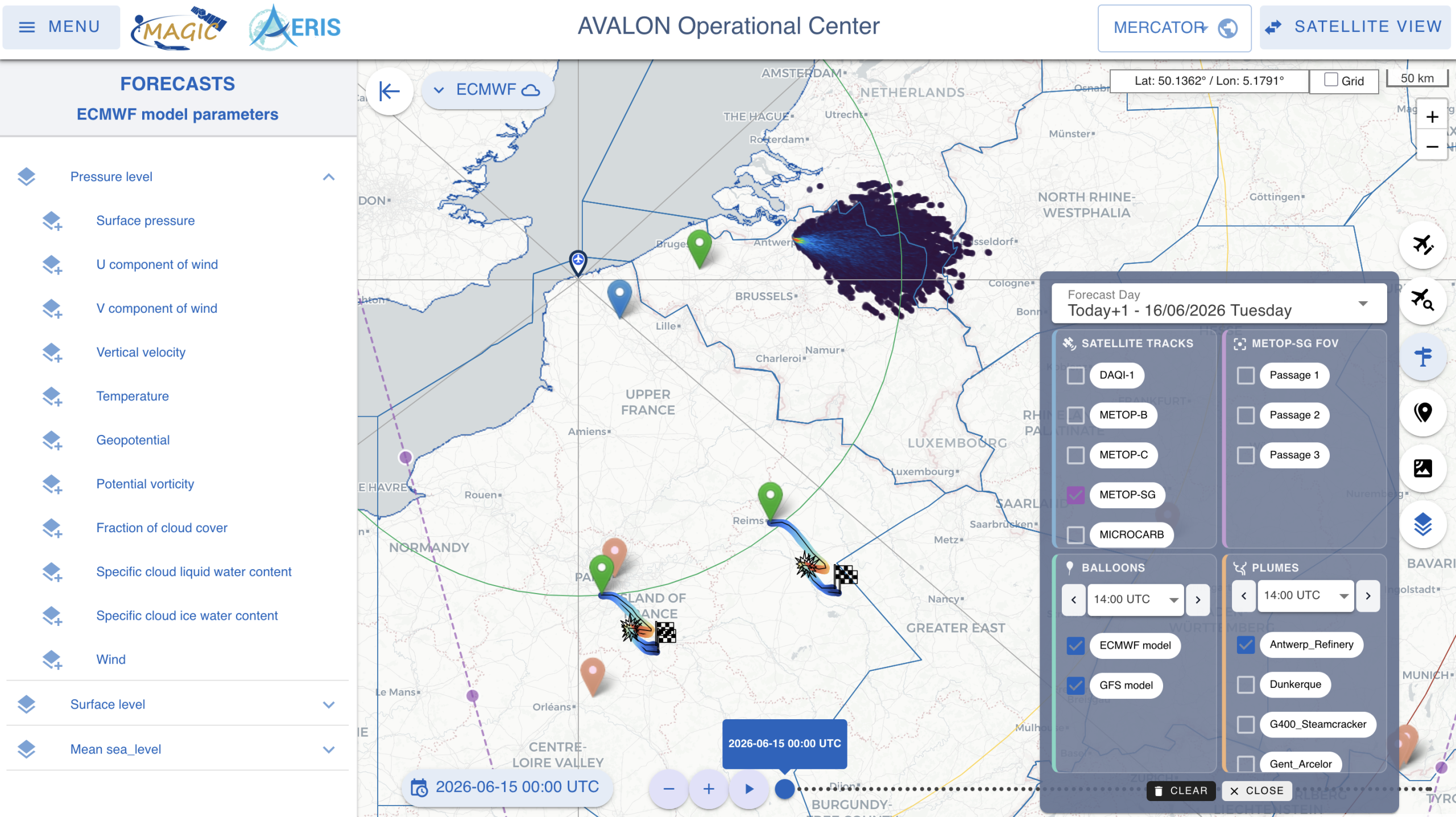
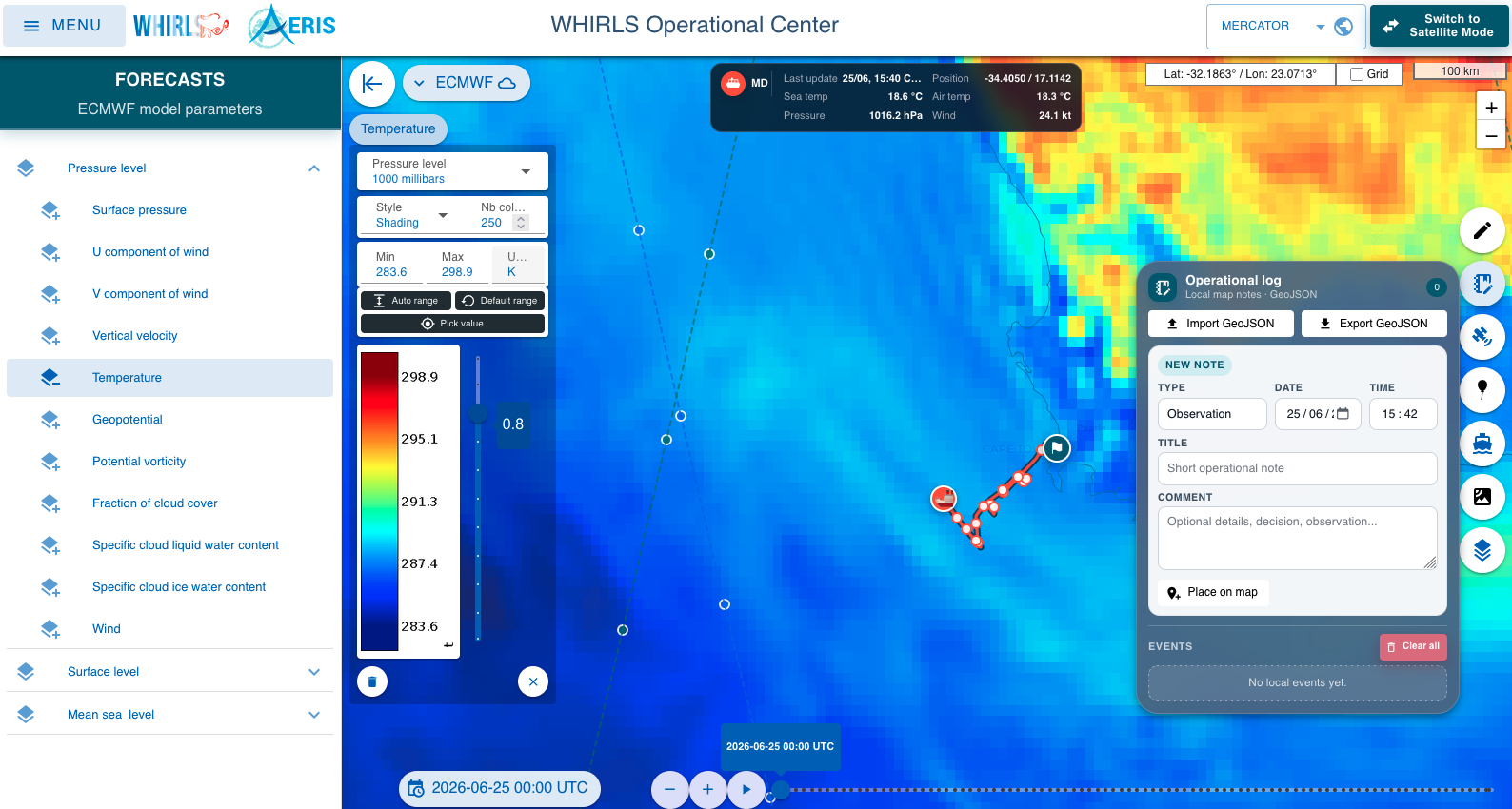
The WHIRLS campaign benefits from the campaign support service provided by the AERIS cluster. As part of this, the AERIS/ESPRI data centre has developed the campaign’s operational website. This operational website includes several features designed to provide scientists with the best possible support during the campaign:
- Real-time tracking and visualisation on a map of the various platforms (vessels, drifters, gliders, etc.)
- Integration of various atmospheric forecast products from the European Centre for Medium-Range Weather Forecasts (ECMWF). Various ocean forecast products are to follow.
- Schedule of satellite overflights (SWOT, Sentinel 1A and 1C)
- Uploading and viewing of quick-looks of campaign data
- Balloon trajectory prediction tool
Support for offshore campaigns: the AdaC service
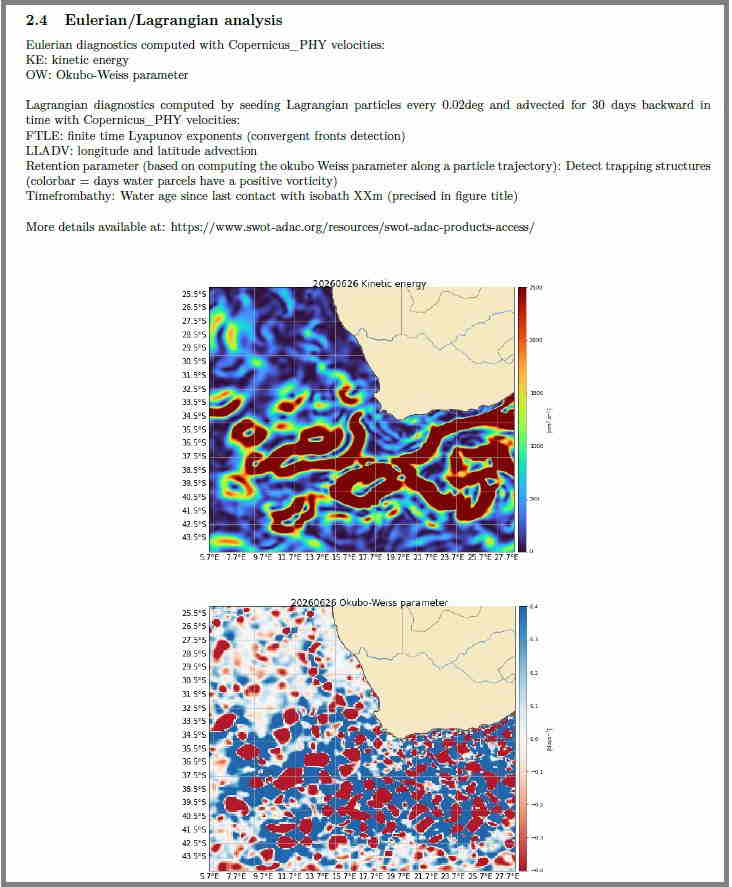
The effectiveness of in situ sampling of structures as dynamic as filaments or fronts depends on an adaptive strategy. As such, the ‘AdaC service’ (Adaptive Campaign), which provides support for at-sea campaigns, plays a crucial role in the campaign. The AdaC service is operated by the CTOH with the support of CNES, and is integrated into the services offered by the IR* French Oceanographic Fleet (FOF) as well as those of the ODATIS centre.
This service provides mission leaders with daily ocean bulletins based on the SPASSO software (extract shown opposite and access to the bulletin of 26 June 2026 in PDF format). By analysing multi-sensor satellite data (altimetry, surface temperature, water colour) in real time, AdaC helps guide vessels and autonomous instruments towards areas of strong physical gradients and high biological richness. Maps of Lagrangian analysis products are also generated and provided to study the fine-scale physical dynamics present at the time of sampling.
This campaign perfectly illustrates the collaboration between Data Terra’s various clusters and how our services complement one another!